Best Complete 1.5kVA Solar System in Nigeria for Home Use (Prices, Setup and Top Picks)
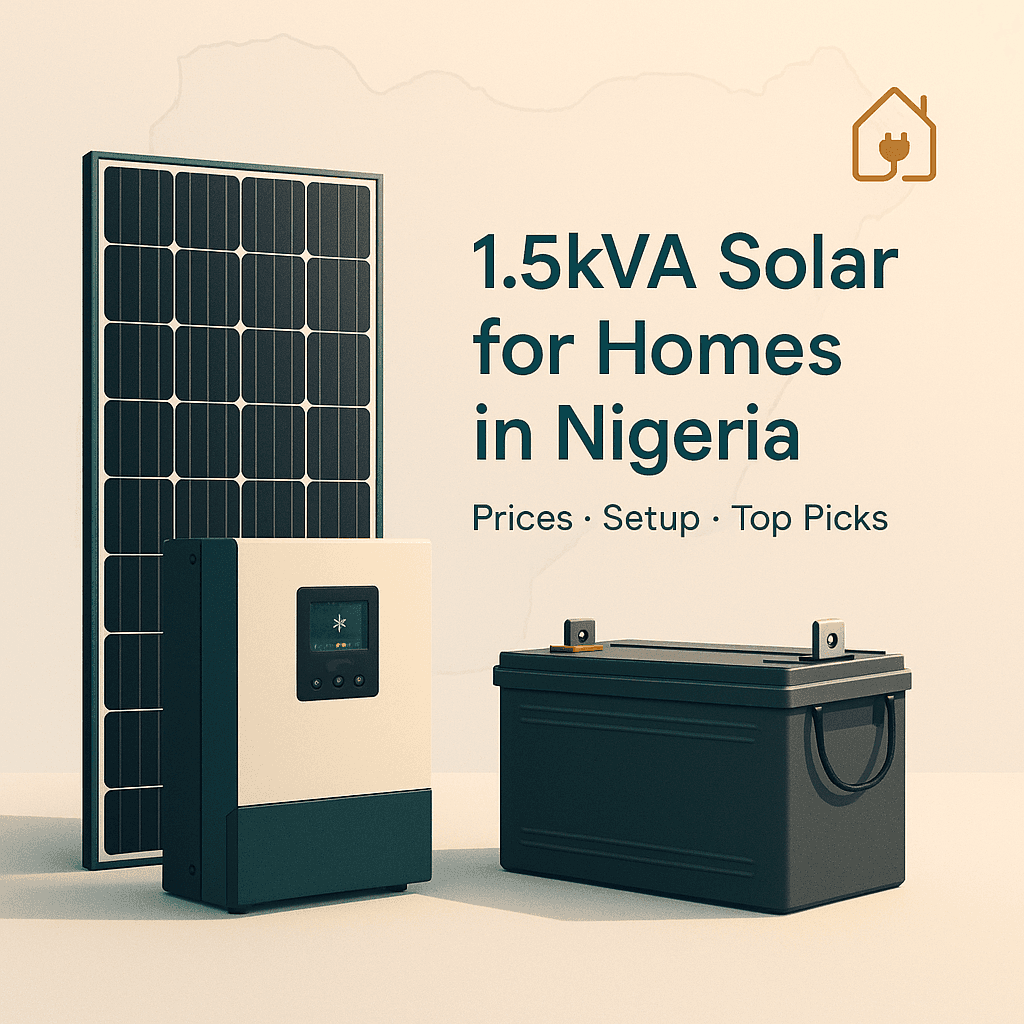
Best Complete 1.5kVA Solar System in Nigeria for Home Use (Prices, Setup and Top Picks)
Nigeria power no dey stable. You already know.
What you want now is a complete 1.5kVA solar system that works, lasts, and comes as a full package. Not “inverter only”. Not missing panels. Not “go and find battery”.
This guide helps you buy the right system fast. You will see real products, what each package includes, current Nigeria pricing ranges, and who each one is for.
Quick answer: the best complete 1.5kVA package for most homes
If you want the best balance of price, reliability, and complete package, start with this:
Main pick (value for money, full hybrid package):
Complete 1.5kVA Mercury Solar System in Nigeria. Full Hybrid Solar Package with 4x 300W Panels
If you want longer battery life and faster charging (and you can pay more upfront):
Lithium alternative (better battery, higher upfront cost):
1.5kW Lithium Solar System in Nigeria. Complete Solar Package with 200Ah Lithium Battery
If your load is growing or you want more comfort (more appliances at once):
bigger system:
Complete 2.4kVA Mercury Solar System in Nigeria. Full Hybrid Solar Power Solution
What “complete” should mean (so you don’t get scammed)
A complete home solar system should not stop at “inverter + battery”. A proper complete package usually includes:
- Inverter (hybrid preferred)
- Solar panels (with correct total wattage)
- Battery (with correct capacity and type)
- Charge control (inside hybrid inverter or separate controller)
- Basic protection (breakers, fuses, SPD)
- Cables and connectors (PV cable, lugs, MC4)
- Mounting or at least mounting plan
- Installation clarity (what you still need to pay installer for)
If any seller is hiding what’s inside, or telling you “everything is complete” without listing components, pause.

Is 1.5kVA enough for your home?
A 1.5kVA inverter is usually best for light to medium home use. Think “essential appliances”, not heavy loads.
What 1.5kVA typically runs well or carry
These are realistic combinations (not everything at once):
- TV + decoder + soundbar
- 3 to 8 LED bulbs
- 1 to 4 fans
- WiFi router
- 1 laptop or small desktop
- Small blender (short use)
- 1 small fridge (depends on compressor starting surge, and your battery strength)
What will stress a 1.5kVA
- Microwave
- Kettle
- Iron
- Pumping machine
- Big AC (even 1HP is usually a bad idea on 1.5kVA)
If you plan to add more loads soon, skip the struggle and move to 2.4kVA now. See:
Complete 2.4kVA Mercury Solar System in Nigeria. Full Hybrid Solar Power Solution
The 3 top complete systems to buy (real products)
Below are the three packages you need for a 1.5kva system in NIgeria. They are compared clearly, with price vs value.
Note on pricing in Nigeria: solar prices change with dollar rate and stock. So treat these as realistic ranges. The product pages show the current price and what is included.
Comparison table (price, value, best for)
| Package | Best for | Battery type | Solar input | What you get | Nigeria price range (typical) |
| 1.5kVA Mercury Complete (4x300W panels) | Most homes that want strong value | Usually tubular/lead-acid based (depends on package spec) | 1,200W panels total | Complete hybrid package with panels | ₦1.2m to ₦2.2m (varies by battery and accessories) |
| 1.5kW Lithium Complete (200Ah lithium) | You want longer lifespan and deeper discharge | Lithium 200Ah | Sized for good daily charging | Complete package with lithium | ₦2.2m to ₦3.8m |
| 2.4kVA Mercury Complete | You want more power headroom | Usually tubular/lead-acid based | Higher system headroom | Bigger inverter capacity | ₦1.8m to ₦3.5m |
This is the best starting point if you want a proper full package with a sensible panel size.
Why this package is a smart buy
- Hybrid setup: it can combine solar, battery, and grid better than old-school inverters, similar to an Ableton hardware hybrid setup.
- Strong panel capacity: 4x 300W = 1,200W panels, which is important because many "1.5kVA packages" in Nigeria come with weak panels like 400W to 600W total.
- Weak panels means slow charging and poor daytime performance, but this package avoids that problem.
- Better chance you enjoy solar in the day and still have battery for night.
Who should buy it
Buy this if you:
- Want a complete system for lights, fans, TV, WiFi, laptops
- Want better charging speed than small-panel packages
- Want value for money without paying lithium price
What to confirm before you pay (very important)
On the product page or with the seller, confirm:
- Battery brand and capacity included
- Inverter model and max PV input
- What protections are included (DC breaker, SPD, changeover)
- Installation scope: mounting, trunking, earthing, distance
Price reality in Nigeria
For a complete hybrid package with 1,200W panels, expect roughly:
- ₦1.2m to ₦2.2m depending on battery size/type and accessories
If you want the simplest safe path, just start here:
Complete 1.5kVA Mercury Solar System in Nigeria (Full Hybrid + 4x300W Panels)

Product link:
1.5kW Lithium Solar System in Nigeria. Complete Solar Package with 200Ah Lithium Battery
If your biggest pain point is battery life, go lithium.
Why lithium is better (in plain terms)
- You can use more of the battery daily (deeper discharge) without killing it fast.
- It usually lasts far longer than tubular/lead-acid.
- Faster charging and better efficiency.
Who should buy it
Buy this if you:
- Are tired of replacing batteries every 1 to 2 years
- Use your system daily (not occasional)
- Want stable power overnight
- Prefer “buy once, cry once”
When lithium may not be worth it
Skip lithium if:
- You only need backup for a few hours sometimes
- You are on a tight budget and would rather increase panels first
Nigeria price reality
Lithium complete packages cost more upfront. Typical range:
- ₦2.2m to ₦3.8m
If battery lifespan is your priority, this is the cleanest choice:
1.5kW Lithium Complete Package (200Ah Lithium)
Product link:
Complete 2.4kVA Mercury Solar System in Nigeria. Full Hybrid Solar Power Solution
This is for you if you already know 1.5kVA will limit you.
Why people upgrade from 1.5kVA to 2.4kVA
- You want to run more things together without “beeping”.
- Your fridge starts better.
- You plan to add more fans, more TVs, or maybe a small workstation.
- You want less stress on the system.
Who should buy it
Buy this if:
- You have a bigger apartment
- You have kids and more devices
- Your load will grow in the next 6 to 12 months
For those considering an upgrade, it's worth noting that many users have successfully transitioned from smaller systems to larger ones like the Complete 2.4kVA Mercury Solar System, which offers a full hybrid solar power solution and can accommodate growing energy needs. If you're interested in sharing experiences or seeking advice about such upgrades, consider joining our Facebook group where members frequently discuss their personal experiences with solar system upgrades and share valuable insights.
Nigeria price reality
Typical range:
- ₦1.8m to ₦3.5m
If you can afford it and you hate limitations, go bigger now:
Complete 2.4kVA Mercury Solar System (Full Hybrid Solution)
Setup: what your installer should do (step by step)
You said you want installation clarity. Here is the simple, correct flow for a home system like these.
Step 1: Mount panels (correct angle and spacing)
- Installer mounts panels on roof with rails and clamps
- Avoid shading from water tank, parapet, or tree branches
- Panels should be accessible for cleaning
Step 2: Run PV cables properly
- Use correct PV cable size
- Use MC4 connectors properly (no twisting and tape)
- Use trunking or conduit for neatness and safety
Step 3: DC protection
Your DC side should have:
- DC breaker or fuse
- Surge protection device (SPD) if possible
Step 4: Install hybrid inverter and battery
- Put in a ventilated area
- Keep away from heat and rain
- Use proper lugs and tight terminals
Step 5: AC wiring and changeover
- Inverter output goes to a selected load board or essential circuits
- Grid/generator input goes into inverter (for hybrid) if supported
- Confirm correct earthing
Step 6: Testing and handover
Installer should test:
- Charging from solar
- Charging from NEPA or generator (if used)
- Load test (TV, fan, lights, fridge start)
- Battery cutoff settings
What people get wrong in Nigeria (and how you avoid it)
Mistake 1: Buying fake panels
How you protect yourself:
- Buy from a known seller
- Confirm panel wattage label and serials
- Avoid “too cheap to be true” 300W panels
Mistake 2: Weak panels for the inverter size
A 1.5kVA system with small panel wattage will annoy you. That is why the Mercury main pick having 4x300W is a big deal.
Mistake 3: Killing batteries fast
Common causes:
- Overloading
- Discharging too deep every day (lead-acid)
- Wrong charging settings
- Poor ventilation and heat
If you want the easiest fix to this problem, buy lithium:
1.5kW Lithium Complete (200Ah Lithium)
Mistake 4: Incomplete system “package”
Some sellers quote inverter price and call it a system. Use this rule: no panels, no battery, no protection list, no deal.
Which one should you buy? (simple decision guide)
Use this table and decide in 30 seconds.
| Your situation | Buy this |
| You want best value, full package, strong panel size | Complete 1.5kVA Mercury Solar System (4x300W panels) |
| You care most about battery lifespan and daily use | 1.5kW Lithium Solar System (200Ah lithium) |
| You already know your loads will increase soon | Complete 2.4kVA Mercury Solar System |
What to ask before delivery (copy and send to seller)
Paste this and send:
- List everything included in the package (inverter model, battery type/capacity, panel brand and wattage, breakers/SPD, cables/MC4).
- Is the inverter hybrid, and what is the maximum PV input?
- Battery warranty and expected cycle life (especially if lithium).
- Panel warranty terms.
- What exactly does installation cover (mounting, wiring length, changeover, earthing)?
- Do you offer after-sales support and troubleshooting?
If they can’t answer clearly, move on.
Final recommendation (buying decision)
If you want one safe choice that fits most Nigerian homes and comes as a proper complete system, buy the main pick:
Complete 1.5kVA Mercury Solar System in Nigeria. Full Hybrid Solar Package with 4x 300W Panels
If you can afford lithium and you want fewer battery headaches, pick:
1.5kW Lithium Solar System in Nigeria. Complete Solar Package with 200Ah Lithium Battery
If you want more breathing space and less limitation, go straight to:
Complete 2.4kVA Mercury Solar System in Nigeria. Full Hybrid Solar Power Solution
FAQs
XStore Team
Store updates, product guides, and practical buying advice from the XStore team.
Discussion
Replies stay threaded so conversations read cleanly.
Comments (0)
No comments yet. Be the first to reply.