She joined Bumpa as a content marketer. Five years later, she’s helping build the product
Precious O’Dahunsi joined Bumpa as a content marketer. Five years later, she’s helping shape its products, bringing creativity and customer insight to product growth.

Promoted
Your Business Needs More Than a Website.
Custom software, automation, web apps, mobile apps and business systems built around how you work.
Build digital systems around the way your business operates.
Explore Software Services
Users of Bumpa, the startup building tools for Nigerian small and medium-sized businesses, are likely familiar with “Gift from Bumpa.”
It is the startup’s chosen avatar for its newsletter, a playful name that has become part of the brand. But many of the people who receive emails from Gift from Bumpa are unlikely to know how the name came about.
When Precious O’Dahunsi joined Bumpa, she needed a name for her official email address. Someone else on the team already bore the name Precious, so that was off the table. She turned instead to a name she barely used: Gift. It turned out to be an inspired choice.
“I knew that this email would be used to send out marketing content for the company and become part of the brand,” she previously shared in an interview.
Customers would see the tagline “Gift from Bumpa” and assume they had received something from the company.
That small act of creativity is emblematic of O’Dahunsi’s career at Bumpa. Five years after joining the company as a content marketer, she has worked across content marketing, product marketing, and product management, eventually moving into product growth. The titles have changed, but the creative instinct has not.
When we begin our conversation, I ask what she is looking for in the content marketer she plans to hire for her team. She wastes little time before naming her two priorities: creativity and ownership.
“You cannot excel at Bumpa without an ownership mindset. What that means is you’re not here to just do tasks; you’re here to see an end-to-end result,” she says.
It is a philosophy that also explains much of her own trajectory. Before joining Bumpa, O’Dahunsi had freelanced as a writer and email marketer for Consonance Club, a community of entrepreneurs and individuals working in tech.
The community was founded by Kelvin Umechukwu, Bumpa’s founder. Since then, she has continued to advise and work with startups and businesses on storytelling and content initiatives.
But her experience at Bumpa has gradually taken her beyond telling stories about products to helping decide what those products should be.
Learning to think like a product builder
From the outside, Bumpa looks like a B2B product because its customers run businesses. But that is not quite how the company sees the problem it is trying to solve.
Nigeria’s low rates of formal employment mean that the informal economy employs more than 70% of its working-age adults. That includes a university graduate who chooses to start a business, but also someone who may be barely literate and have little experience with technology.
Building for both groups means Bumpa cannot assume that its customers understand the conventions of business software.
“You, as someone who works in tech, know of Shopify, but many of these people have never heard of Shopify. When you’re building for people who have never encountered what SaaS looks like for their business, you’re looking for simplicity.“
That principle cuts across Bumpa’s product, whose solutions span business operations, payments, analytics, and inventory.
Each of those categories can quickly become complicated. Inventory alone, for example, can involve multiple locations, employees, and thousands of individual products. Payments can mean multiple accounts and payment channels.
Bumpa’s challenge is to hide that complexity rather than pass it on to the customer. O’Dahunsi says this is particularly important because Bumpa is often the first experience many of its customers have with business software. A product that requires too much explanation risks becoming a product they simply stop using.
The second principle is scale, which she describes as building tools that can grow alongside customers as their businesses become more sophisticated.
As an early player in Nigeria’s social-commerce space, Bumpa has watched some of its earliest customers evolve from small operations into businesses with multiple locations and larger teams. Their demands have evolved with them.
Requests for a simple storefront have given way to requests for inventory tracking across multiple locations and larger employee counts. Some customers even use the business data generated through Bumpa for grant and visa applications. In other words, the product has had to grow because its customers have grown.
From telling stories to shaping products
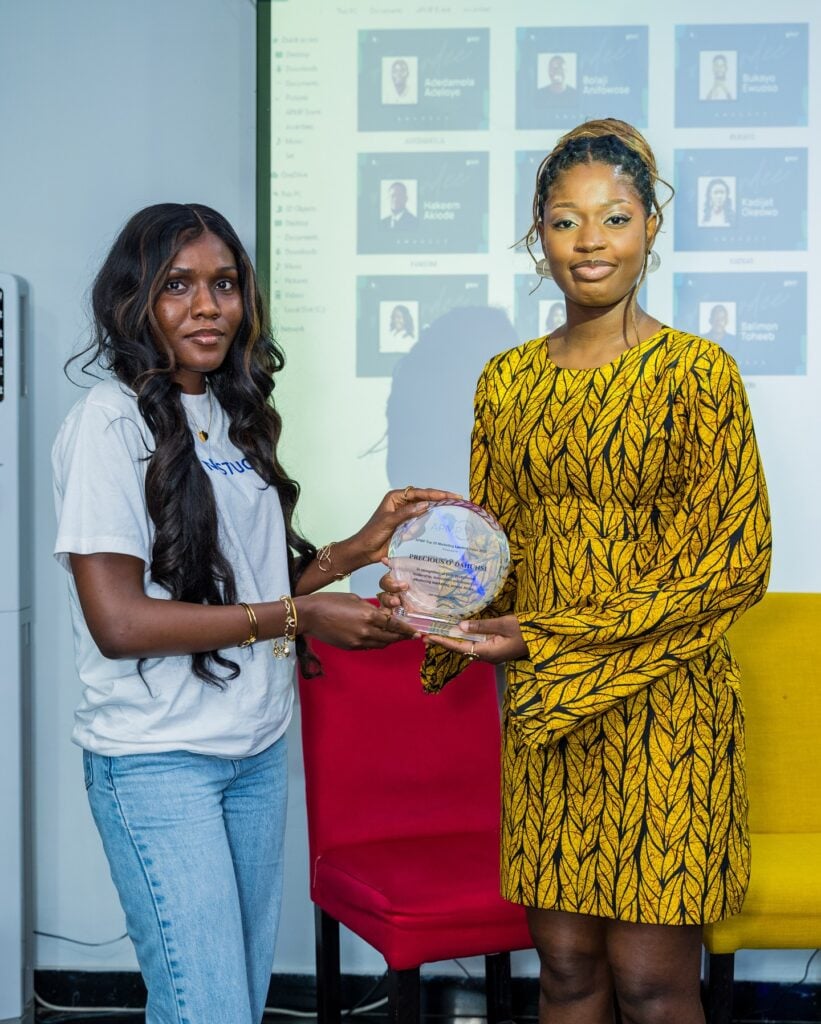
O’Dahunsi’s movement between content marketing, product marketing, and product management has given her a perspective on the overlap between the three roles. The clearest overlap, she says, is between content and product marketing.
“There’s almost nothing a product marketer can do that a cracked content marketer cannot do,” she says, although she adds that product marketing requires a deeper level of technical knowledge.
Product marketing, meanwhile, overlaps more closely with product management. That experience has shaped how she approaches her current work.
Rather than simply building features that appear useful, she says she is able to bring the instincts she developed as a marketer into product decisions: identifying customer pain points, understanding how people discover products, and thinking about how a feature fits into the broader customer journey.
There are, however, important differences between the roles. Content marketers, she notes, are typically not burdened with revenue conversations in the same way product marketers and product managers are. For the latter two roles, building something useful is only part of the equation. The product must also contribute to the company’s bottom line.
There is also a difference in agency. A content marketer or product marketer can have strong ideas about what a product should become, but a product manager ultimately has greater influence over what gets built.
That distinction leads to another question in our conversation: what exactly does a product manager do? There is a persistent view in tech that product managers are little more than glorified taskmasters — people who follow up with engineers, designers, and other members of a team to make sure work gets done.
O’Dahunsi says she had heard the argument herself before becoming a product manager. But after moving into the role, her view changed.
She acknowledges that she has only been a product manager for a relatively short period but argues that the role is less about chasing people for updates and more about keeping the bigger picture in view.
A product manager, she says, is responsible for getting different parts of a team rowing in the same direction. Even in a great team, she argues, there can be a cost to not having someone whose responsibility includes keeping the organisation’s goals front and centre.
That means asking the fundamental questions: who are we building for? What are we building? When should we build it? And how should we build it? The product manager, in her telling, is also a translator.
“A product manager takes the pressure that a CEO has from the market or investors, processes it, and breaks it into minute chunks for the team.”
Bumpa’s competition is getting closer
For at least half of its existence, Bumpa operated in a category with relatively little direct competition.
Over the last two years, more startups have entered the market with similar ambitions, but O’Dahunsi does not appear particularly worried about the growing field.
Her first argument is around market size. Even with several companies competing for the same customers, only a portion of the total addressable market has been captured.
Her second argument is historical. Other startups have attempted to build similar products at various points, she says, but many have fizzled out. For Bumpa, surviving long enough to see its customers grow is itself an advantage.
Then there is something harder to quantify: the people behind the product. Bumpa has built a degree of affinity between its employees and customers that O’Dahunsi believes competitors may find difficult to replicate.
Umechukwu, the company’s CEO, has a significant online presence and frequently appears in advertising and promotional materials alongside customers. O’Dahunsi’s own social media activity has also helped customers discover Bumpa and eventually become users.
That kind of personal connection is difficult to manufacture. There is still the possibility that as Nigerian businesses become more sophisticated, some will look to foreign SaaS products such as Shopify. But O’Dahunsi believes Bumpa’s deeper understanding of the Nigerian customer can give it an edge against international competitors.
For her, the advantage is not simply that Bumpa was built in Nigeria. It is that the company has spent years learning how Nigerian businesses actually operate.
Hiring for the person, not just the résumé
O’Dahunsi’s unconventional path into Bumpa has also influenced how she thinks about hiring.
As Bumpa’s first marketing hire, she did not arrive through the kind of conventional career path that might make a résumé easy to evaluate. Her experience has made her less interested in educational qualifications when hiring for entry-level roles.
Instead, she looks for how candidates think about problems and how they approach their work. Everything else, she believes, can be improved.
The calculation changes for senior hires, where she expects to see a track record of what candidates have done and the results they have achieved.
It is another expression of the ownership mindset she identified at the beginning of our conversation.
For O’Dahunsi, the strongest people are not necessarily those who arrive with the most impressive credentials. They are the ones who see a problem and feel responsible for seeing it through.
“Every hire is a good hire until proven otherwise,” she says.