Paga out, Lemmy MFB in: What LemFi’s banking shift means for African remittances
LemFi is shifting naira operations from Paga to its own entity, Lemmy MFB, as it seeks greater control.

Promoted
Your Business Needs More Than a Website.
Custom software, automation, web apps, mobile apps and business systems built around how you work.
Build digital systems around the way your business operates.
Explore Software Services
For years, the arrangement made perfect sense to everyone involved. LemFi, the UK-founded remittance company, needed a way to get naira into the hands of Nigerian residents receiving money from the UK or Canada. Paga, one of Nigeria’s oldest mobile money operators, already had that infrastructure built so LemFi’s naira wallet ran on Pagatech’s rails.
LemFi paid Paga for the privilege, and Paga generated revenue off it. That arrangement is now quietly coming apart, and it says something about where Nigerian fintech is heading.
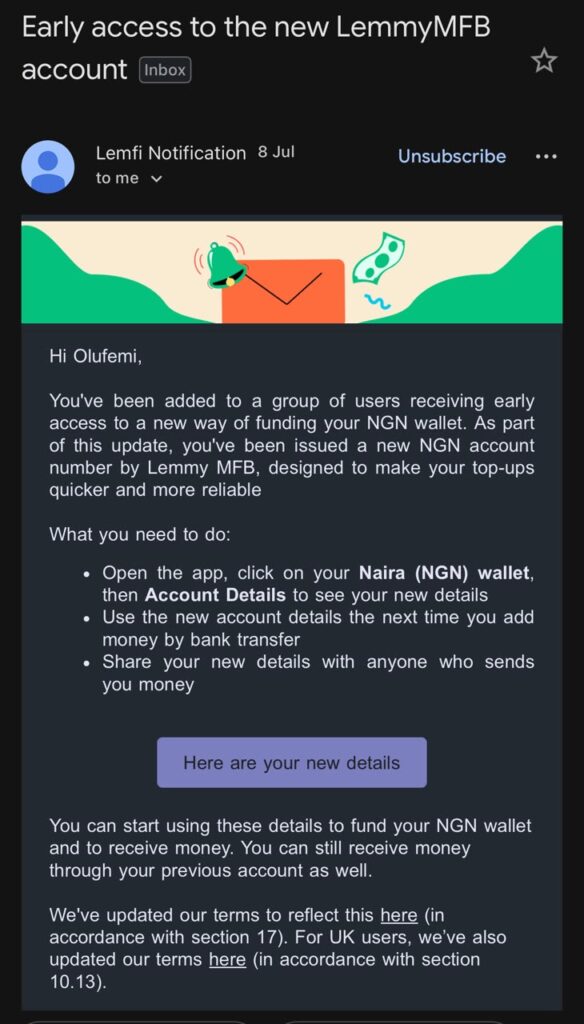
Buried in LemFi’s legal terms and updated as recently as July 2026 is this clause: the company “may move your NGN account between providers (for example, between Pagatech and Lemmy MFB).” Users were also given a new account number as part of the changes.
After years of paying Paga to hold and move its customers’ funds, LemFi now has its own bank to do it instead.
LemFi’s move shows a pattern of intentional ownership
LemFi isn’t alone in wanting to own its rails. Moniepoint, barred from routing FX through its own microfinance bank because Nigerian MFBs cannot legally touch foreign exchange, built a separate app, Monieworld. That allowed it to route transactions through a UK EMI partnership and a distinct IMTO subsidiary, Global Wire.
Paystack took a different route entirely, partnering with Titan Trust Bank, a licensed commercial bank, to power Paystack-Titan virtual accounts and, later, its consumer wallet product Zap. OPay has its own MFB. So does Moniepoint.
Nomba runs Nombank, whose MD has publicly framed the industry’s trajectory in blunt terms: “every significant Nigerian fintech eventually hits the same ceiling: you can move money, but you can’t hold it.”
Different structures, same underlying instinct. Fintechs that once rented settlement infrastructure are now building or buying theirs.
Why now?
Adebare Akinwunmi, a Lagos-based lawyer who has worked in fintech, frames the shift as straightforward commercial logic.
“Having an affiliated financial institution as agent for its naira payout operations offers significant commercial and operational advantages over relying entirely on an unrelated third party,” he says. “It potentially means lower third-party fees, improved margins, higher transaction volumes, and, importantly, greater control over the customer experience.”
Beyond the remittance transaction itself, Akinwunmi notes, owning the infrastructure lets an IMTO retain and serve that customer across a broader financial ecosystem. In other words, building savings, lending, or other products on top of an existing user base, rather than handing that customer off once the transfer clears.
A fintech operator who has watched this play out from the inside agrees but argues that the real driver is somewhere else.
“OPay didn’t get an MFB just because money transfer margins are thin,” the operator says. “They do it because CBN policy makes it the only path to scale deposits.” The CBN, therefore, doesn’t need to mandate vertical integration explicitly; it just needs to make the alternative prohibitive. “They’ve made the regulatory risk of operating as a non-bank fintech holding material deposits prohibitively high. So every fintech that wants to offer lending, savings, or customer float does the math and concludes: licence an MFB or partner with one.”
Both agree that this isn’t a move available to everyone. “I would expect this model to be most attractive to larger remittance players with significant transaction volumes and ambitions beyond simply facilitating remittances,” Akinwunmi says. The operator agrees, adding that well-capitalised local players with strong regulatory relationships will often choose to go down this path.

A partnership with an expiry date
If there’s a warning buried in this trend, it’s for companies like Paga and, implicitly, for any fintech whose business model depends on being someone else’s infrastructure.
“This is actually more common than people realise and is almost always a ticking problem,” the operator says. “The arrangement makes perfect sense at inception. Paga built infrastructure that LemFi couldn’t replicate faster or cheaper. Paga collects fees. LemFi gets market access. Economics align. But that stability only survives until one party recognises the market they’re building together has value they could capture directly.”
Akinwunmi is more measured but arrives at a similar conclusion. As IMTOs internalise their payout infrastructure, he notes, some of that volume could move away from independent MMOs. However, he adds that this doesn’t threaten their business models outrightly, given how much of Nigeria’s population remains financially underserved.
The two sources split hardest on how deliberate all of this is. Akinwunmi points to the CBN’s 2024 IMTO guidelines, which require that inbound remittances above roughly $200 be paid into an account and, critically, specify that where a beneficiary lacks an account with the IMTO’s agent bank, that agent bank must credit the beneficiary’s account elsewhere.
That provision, he argues, already protects customer choice. An IMTO can certainly offer an affiliated MFB or wallet as a convenient option, but there is a distinction between offering that option and making it the compulsory channel.
The operator sees something closer to a loophole being exploited. “CBN’s framework wasn’t exactly built for this. It was exploited to enable this,” they say.” The framework said, ‘MFBs can’t touch FX,’ and fintechs reasoned: ‘OK, we’ll separate it structurally.’ That’s not the same as CBN approving the architecture. It’s regulatory arbitrage that’s currently tolerated because remittance inflow is politically valuable to CBN and the Governor.”
What comes next?
Neither source thinks the current shape of the industry remains unchanged. Akinwunmi expects the CBN to eventually clarify customer choice, disclosure and the relationship between an IMTO and an affiliated financial institution rather than overhaul the framework outright.
The operator predicts something closer to what happened in Nigerian banking itself: a tiering, where scale and capital determine who ends up owning their own rails and who doesn’t.
“I think what we will likely see in 2-3 years is the same thing we have seen with the banks,” they say. “The big boys are tier 1, and then people start taking positions depending on their capital and asset base, licensing and group structure stack.”
Paga did not respond to requests for comment on this story.