Philanthropy in Africa’s largest startup ecosystem should be data-driven
Why Africa’s largest startup ecosystem needs data driven philanthropy and real due diligence
Promoted
Your Business Needs More Than a Website.
Custom software, automation, web apps, mobile apps and business systems built around how you work.
Build digital systems around the way your business operates.
Explore Software Services
Nigeria is the most generous country on earth. According to the World Giving Report 2025, 89% of Nigerians donated money in 2024, the highest proportion of any country surveyed globally, and gave an average of 2.83% of their income to charity, also ranking first worldwide. These are extraordinary numbers. They are also, from an impact standpoint, beside the point.
The volume of giving says nothing about where the money goes, whether the interventions work, or whether the outcomes would have occurred anyway. And in Nigeria, despite the generosity, the answer to those questions is, in most cases, unknown. According to the latest report by FP Analytics on the state of Nigeria’s diaspora philanthropy and remittances in meeting the SDGs, impact measurement is largely informal, as most donors do not track the impact of their donations or establish impact metrics for assessment. Furthermore, research on African philanthropic behaviour finds that giving is predominantly motivated by kinship, rather than impact lines.
These seem to be the current pattern in the Lagos startup ecosystem. For example, I reviewed publicly reported philanthropic activities by Nigeria’s fintech founders and found that most donations fell into one of three categories: alumni/prestige giving to one’s alma mater or home community, crisis response/visible solidarity, and talent pipeline for the company.
These aren’t wrong; they are expected responses to cultural incentives that long predate Nigeria’s tech boom. But I believe tech philanthropy can be better and set the lead for effective philanthropy.
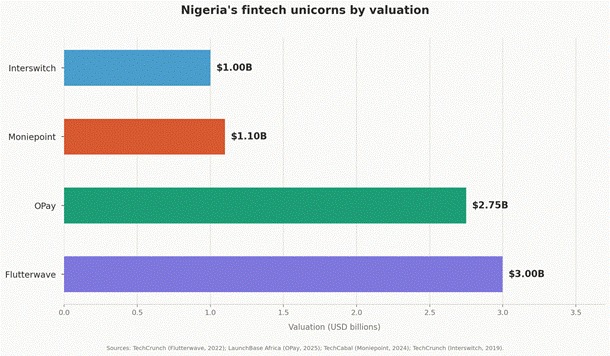
Nigeria has minted five tech unicorns, with Flutterwave valued at $3 billion, OPay at $2.75 billion, Moniepoint crossing $1.1 billion, and Interswitch sustaining its billion-dollar valuation. Currently, the Lagos ecosystem’s total value exceeds $15 billion. These companies did not get there by trusting their instincts. They got there by building data infrastructure, measuring outcomes, and allocating capital to the highest-return areas. Their investors understood additionality and counterfactual reasoning. They stress-tested assumptions. They demanded evidence before writing cheques into deals.
Yet that discipline evaporates when it comes to philanthropic capital. The opportunity cost may be invisible, but it is real: a donation to a cause the donor knows personally may be a low-return use of capital relative to an evidence-backed intervention with demonstrated, replicable results at scale.
Effective philanthropy – What Silicon Valley built
In 2015, a small group of entrepreneurs in London and San Francisco launched Founders Pledge, asking startup founders to commit a portion of their personal proceeds to charity when they exited. Members received research-backed recommendations on where their capital would do the most measurable good, vetted by an in-house team applying cost-effectiveness analysis to global health, climate, education, and existential risk.
A decade later, Founders Pledge has 2,200 members who have pledged over $12.8 billion, with $1.7 billion already deployed to high-impact causes. For every dollar invested in Founders Pledge’s operations in 2025, $31.10 was donated to the charitable sector. Members include founders of Bolt, Klarna, Wise, Unity, and Webflow.
The effective altruism movement that underpins this culture draws on a straightforward insight: charitable capital, like venture capital, should be deployed where it generates the highest return per dollar.
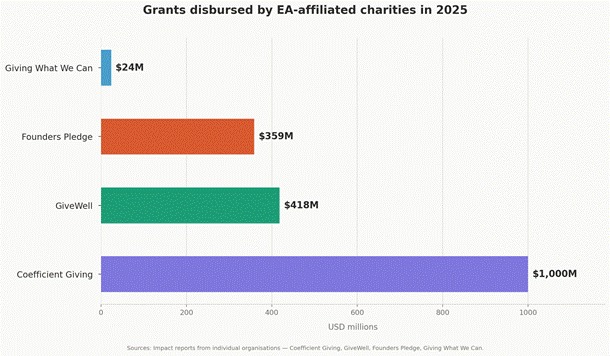
Besides Founders Pledge, this movement has birthed other non-profits dedicated to effective giving: Coefficient Giving, GiveWell, and Giving What We Can, allocating $24M to $1B in 2025.
Effective philanthropy – what can it look like in Lagos?
To be sure, we don’t have to import Silicon Valley’s philosophies en bloc. But we can adapt to its core insight that philanthropic capital, like commercial capital, deserves due diligence. What does this possibility look like?
The theory of change
Before committing funds to a philanthropic project, ask for the theory of change. The theory of change is just like an investment thesis. A strong thesis explains causal logic. Likewise, a theory of change. It says: “If we do X, then Y happens because Z is true about this problem.” It has assumptions you can stress-test, a causal chain you can track, and a failure mode you can spot early.
Move from inputs to impact
When a funder thinks about a philanthropic activity, he’s more focused on costs than impact. I know this because I’ve been there. We want to know the cost of the outreach, the medical equipment, or the laptops. We rarely give the same thought to the impact of these donations. However, just as we make budgets to estimate costs, we can estimate impact with back-of-the-envelope calculations. We can look through current evidence, use Fermi estimates, and, in cases where data is scarce, make informed guesses. Doing this compels us to be explicit about the assumptions/biases feeding our philanthropic choices.
Data infrastructure
Nigeria lacks consistent data on numerous socioeconomic metrics. This is a real pain because researchers have had to model effects using outdated data. Without data, it is difficult to quantify the scale of a problem, its tractability, or the depth of neglect.
While multilateral development organisations have typically done the heavy lifting, there is room for techpreneurs to come in. For example, because they have access to large swaths of consumer/customer data, they can publish real-time data that provides insights into trends in employment, health, food, education, and others.
Moniepoint is a great example. In 2024, it published its first report on Nigeria’s informal economy, based on data from more than 2 million business owners. In 2025, the annual report expanded to cover data from 5 million business owners and surveys from more than 3,000 businesses.
Community
Founders’ Pledge succeeded because a community of peers normalised rigour, shared research, and held each other accountable to the commitments they made. Nigeria’s tech founders interact constantly at summits, in Slack groups, through investment syndicates. Can they build an effective giving community on top of this infrastructure?
In conclusion, while Nigerians are no strangers to philanthropy, the volume of philanthropy says nothing if we can’t measure impact or use data to target high-impact, high-additionality areas. Fortunately, the Lagos tech ecosystem is uniquely placed to champion the rise in effective philanthropy.
Nzube Ifediba is the founder of Paper and Quill Consulting, an advisory firm applying investment-grade due diligence discipline to philanthropic capital for African and diaspora high-net-worth individuals and foundations. She is based in the United Kingdom.