Swoop wants Nigerians to trust them to deliver food
Swoop says its mission in Nigeria is simple: earn customer trust. After raising $7.3 million and attracting over 20,000 users in six weeks, the food delivery startup is betting tha
Promoted
Your Business Needs More Than a Website.
Custom software, automation, web apps, mobile apps and business systems built around how you work.
Build digital systems around the way your business operates.
Explore Software Services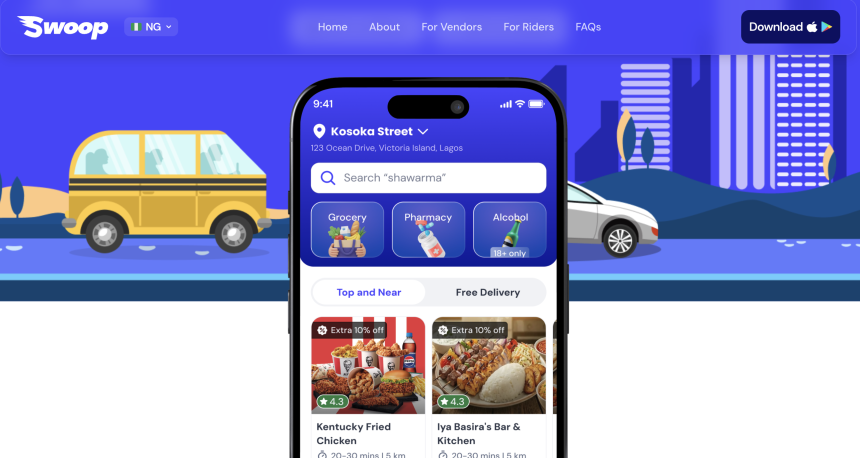
By 12:47 p.m., Ngozi has already missed the window to prepare lunch. She realised this as she ended her fourth consecutive hour of back-to-back calls, exhausted from the frequent “can you see my screen?” requests in between. Her friends and family have constantly warned her about her ulcer.
Too tired to cook, she has to find a reliable way to get food without breaking the bank. If she chose to place an order on a food delivery app. She wants it in minutes.
Ngozi is the person that every food delivery company in Lagos says it is building for.
Swoop, the latest foreign entrant that raised $7.3 million in seed funding, says its main goal is to earn Nigerians’ trust. This was revealed in an exclusive chat with Condia.
With over 20,000 users in six weeks of operations. Demola Adesina, country manager, says the biggest concern is maintaining trust: “We want to ensure that there’s trust across the entire chain of the transaction”.
Read also: Swoop’s 100% rider model exposes the fragile unit economics of Lagos food delivery
Why is trust important in the market

The unit economics of the food delivery market are fragmented. As Adesina said, many factors come into play in satisfying users: the payment must be made, the restaurant must act on the order, the assigned rider must deliver on time, etc. A lot of things could go wrong amid all this. However, this is a vantage point; Swoop intends to maximise it via operational efficiency, fair pricing and transparency. “We want the process to be profitable for all those involved,” he added.
He claims that this centres on how everything in Swoop is being conducted. Preferring to celebrate operational efficiency rather than user milestones, the merchant onboarding process includes a physical site inspection, the rider-hiring process, and riders receiving 100% of the fees, with Swoop taking a 7% service charge from the store with no hidden fees accruing to the restaurant or customer.
With this, he believes they need not worry about competition. As the saying goes, the sky is big enough for every bird. Swoop is going after the market gap that the other birds haven’t occupied. “We believe there’s a huge market that remains underserved. A huge bucket of people who are app consumers right now, but not food-delivery app consumers. And our role is to be the bridge that takes them from being app consumers to food delivery app consumers.” Adesina said this is the picture of their main customer focus.
The non-consumer bet, rider model and on the super app
The idea of a non-consumer focus poses many challenges, as it is a three-sided business involving merchants, riders, and users. According to him, this will require education, incentives and social proof. All these are tied to the user’s first experience.
The customer reviews on the Apple Store praise the app’s user experience and rider behaviour, and there are about 2 complaints about delivery time, which Adesina said they have addressed using algorithms to keep delivery under 30 minutes.
The non-consumers are broken into three batches. “The first set of people orders food online. We are telling them that they can get better service with us. You can get your food faster and pay less. The second set consists of app users who don’t order food online, and the third set consists of people who don’t use apps at all. Our goal is to get them to start consuming,” Adesina explained. “One is to get them to hear about us; two, is to trust that they will get a good experience; three, is to get them to give us their money”
As stated earlier, all of these require education. Most of which has been done by prior players in the field.
It operates in Yaba, Surulere, and parts of the Lagos mainland and plans to expand quickly to other neighbouring cities.
Swoop prides itself on offering the lowest prices in the market and believes it is sustainable. “Our riders are happy. We set the prices considering distance and have been able to absorb 20% of the riders that applied to work with us from a long waitlist,” said Adesina. Swoop trains its riders and offers compensation and bonuses in addition to the delivery fee.
Aubrey Niederhoffer, Swoop’s founder and CEO, had previously noted that Africa’s lack of credit card infrastructure is an advantage in positioning the company. The existence of the Swoop wallet suggests this might be a foundation for a fintech branch-out. “We will continue to grow and evolve, but for now, the wallet only serves as a store value for app credits so users can load up their app credits and use them to buy food. The direction of the super app would be as per customer demands.”
Swoop defines success as trust. “If people come back every day to order, give us their money, convert it to our store credits and have it sit in their wallets”. We have won.