VitalSwap CEO Akinsola Jegede on how CBN’s Form Q impacts fintechs
VitalSwap founder Akinsola Jegede breaks down the Central Bank of Nigeria's Form Q requirements, what they mean for cross-border transactions, and how fintechs must adapt.

Promoted
Your Business Needs More Than a Website.
Custom software, automation, web apps, mobile apps and business systems built around how you work.
Build digital systems around the way your business operates.
Explore Software Services
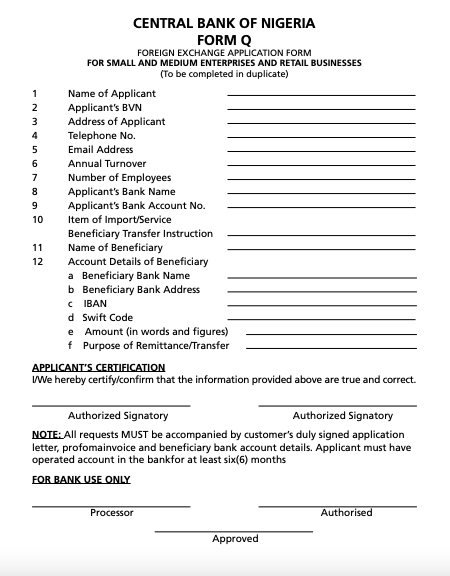
Commercial banks across Nigeria have started marketing Form Q more actively in recent weeks, putting the long-standing CBN channel for official-rate dollars in front of small and medium-sized businesses that need to pay overseas suppliers. The shift has prompted conversation among customers and fintech founders who serve many of the same customers.
Akinsola Jegede, founder of VitalSwap, offered a measured reading of what the renewed visibility of Form Q actually signals for companies working in payments, SME services, and cross-border corridors.
Form Q allows qualifying SMEs to purchase limited foreign exchange at the official rate and send it directly to suppliers abroad. For a long time the form sat unused in practice because supply rarely matched the scale of demand. The current push from banks suggests liquidity conditions have improved enough for them to promote it again. Jegede sees the development as constructive yet incomplete.
How Form Q availability lands for SMEs and platforms
“It is certainly a good step in the right direction,” Jegede said. “However, the reality is that the demand for foreign exchange in Nigeria still significantly exceeds what is currently available through formal channels. That gap creates an important role for fintechs, particularly in providing liquidity, improving access, and making cross-border payments more efficient.”
He added that increased FX supply from official channels is positive for the wider ecosystem, but it does not remove the need for specialised platforms. Instead, it pushes fintechs to address different parts of the problem.
On the ground the numbers remain telling. Jegede noted that an average SME can easily require around $50,000 a month for legitimate international activity, while the amounts reachable through the banking system often leave a shortfall.
“If banks can consistently provide more of that demand at the official rate, it should reduce SMEs’ reliance on the parallel market,” he explained. “At the same time, it will inevitably affect the volumes some SMEs push through fintech platforms. How significant that impact will be depends largely on whether this level of FX availability can be sustained over time.”
The competitive landscape shifts in parallel. Greater access to Form Q strengthens traditional banks in the SME segment because they already hold the balance sheet, the regulatory standing and direct foreign-exchange capacity.
“Absolutely, it makes banks stronger competitors,” Jegede observed. When banks make official-rate dollars easier to obtain, they close gaps that fintechs have filled for years. The same pattern appears in remittances, where rate differences quickly influence customer choices. Still, he sees meaningful room for collaboration.
“Banks have the balance sheet, regulatory infrastructure and FX access, while fintechs often have the technology, customer experience and distribution. Collaboration between the two, particularly around remittances and cross-border payments, could create a much stronger proposition for customers.”
The problems Form Q leaves open for fintechs to solve
Even with more Form Q capacity in circulation, everyday frictions around trade persist. Documentation needs to become simpler, pricing more transparent, and supplier payments and inventory financing cleaner.
“Fintechs will continue to innovate around whatever problems customers are experiencing,” Jegede said. “Easier access to official FX does not eliminate the need for better trade documentation, transparent pricing, supplier payments or financing. If anything, it creates an opportunity for fintechs to build products that make the entire process simpler and more trustworthy for SMEs. The companies that understand the customer problem and build products customers trust will continue to have an advantage.”

The effect on the parallel market itself cuts in two directions. Additional official supply through Form Q should ease some pressure, yet periods of heightened activity in the informal market continue to surface. Jegede described the situation as a double-edged sword and said he is watching closely, along with the rest of the industry, to see whether the improved supply can be sustained and whether it proves large enough to meet underlying demand without fresh spikes or volatility.
Licencing decisions sit in the background of these calculations. Several fintechs have secured or are pursuing banking and microfinance licences. Improved Form Q access influences how some of them think about trade-related or FX-adjacent products, yet Jegede was clear that strategy cannot rest on any single regulatory channel.
“As an organisation, we cannot build our strategy around one particular regulatory product or channel. If our customers’ needs are changing, we have to evolve with them. Banking and MFB licences can create additional opportunities, but the fundamental objective remains the same: finding better, more efficient and more compliant ways to support customers with their financial and cross-border needs.”
The renewed marketing of Form Q registers as progress for the market. It lowers certain barriers for SMEs and indicates that formal channels are operating more actively than they did during tighter periods. For fintechs the implications arrive in layers. Volumes in some corridors may soften if banks satisfy more demand directly. Competitive pressure from banks will increase wherever official FX becomes a decisive factor.
At the same time the remaining gaps in liquidity, speed, transparency and experience leave clear space for specialised platforms. Partnership models that combine bank-grade access with fintech distribution and product design look especially promising.
Jegede framed the moment without overstatement. Progress is real, the demand gap remains, and the companies that stay closest to the daily problems of customers will be the ones that continue to matter as Form Q finds wider use.